


財團法人公共電視文化事業基金會 All Contents Copyright,Taiwan Public Television Service.
客服專線:(02)26332000
傳真電話:(02)26349136
114 臺北市內湖區康寧路三段75巷70號


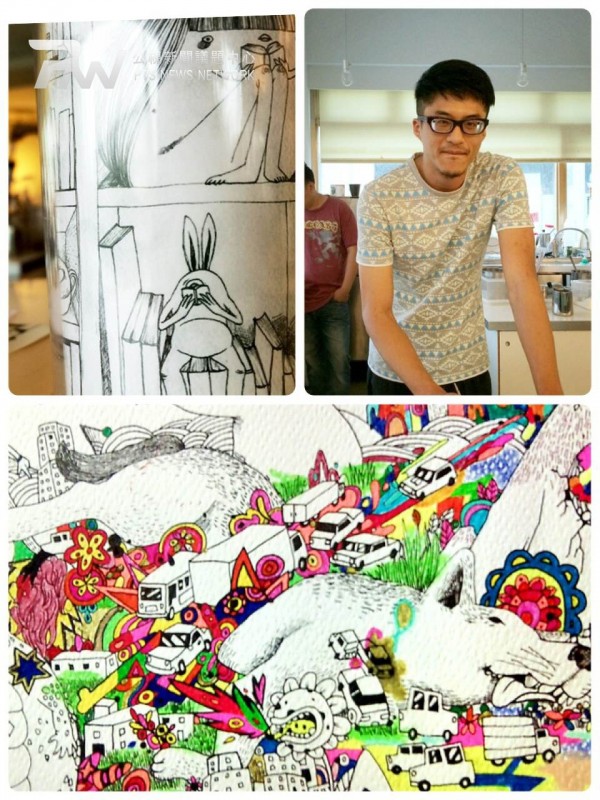
Usually very reticent when engaged in conversation, Cicold is an artist who works days at a cafe. He wears thick glasses that obscure his eyes, making it even more difficult to glean what he might be thinking. His drawings, however, are expressive, sophisticated and full of imagination. On paper, some customers who visit the coffee shop where he works become monsters who look like big meatballs, while others have several eyes, grotesquely long legs, or gaping mouths covering their bodies. Sometimes, he says, the monsters he creates feel more real and more friendly than real life humans do. He visits this world often when he tires of looking at the world logically or realistically, opting instead to allow his imagination to make his routine life more vivid or even surreal. For example, life becomes far more interesting when coffee cups sitting on a table that need to be washed are allowed to walk around on their own thanks to the gift of his imagination.
木訥少言的夕摳是一位畫家,白天在咖啡店工作,他戴著一副厚重的黑框眼鏡,下巴留著一搓短短的鬍子,個性低調靦腆。他筆下的世界細膩而富有想像力,在他的畫裡,上門的顧客們幻化成各式各樣的怪物,走進咖啡店,塞在一格一格的書架牆看書打盹,有大肉球怪,長腳怪,複眼怪,多嘴怪。他說,怪物比人類更真實可親,用現實眼光看待事物太無聊了,例如他想像桌上的杯子會動,這樣一來,生活有趣多了。
His artwork gives a sense of sarcasm or even mocking due to his use of disproportionate sizes. In contrast with reality, small animals become giant, while objects in human civilization, such as cars and high rises, feel small and insignificant. Animals have already suffered so much from being under humanity, so he wants to add some liveliness and grandeur to them in his drawings. Although the scenes portrayed in his drawings are often melancholy, the colors are always bright with strong contrasts. He explains this by saying too humbly that he cannot perceive colors very well, and also that he sometimes hopes to make his work purposefully less gloomy through the use high contrast colors, adding a touch of irony to his subject matter.
Another often visited theme in his work is environmental pollution. He views industrial pollution as the result of humanity’s unchecked desire. Though a part of human civilization and counted among the humans that destroy the environment, he feels his kind is the most despicable creature of the world. Only humans would excessively consume beyond their basic survival needs; and only humans would continue to exploit natural resources when ecological systems are already deeply damaged. Not only animals living alongside humans are being pushed toward extinction, but the environment that supports humanity’s existence is also being destroyed. With bitterness in his tone, he points out that modern humans are even less ecologically balanced than pre-historic humans. Animals, he points out, didn’t become roadkill under the wheels of trucks back then.
他的畫裡常利用換位創造嘲諷感,小動物們總是巨大得不成比例,文明社會的產物如車輛與高樓大廈則顯得卑微渺小,像是玩具一樣。雖然畫面主題悲傷,但是用色鮮艷。他說,一方面是因為他辨色能力較弱,一方面也是因為想藉由對比強烈的色彩,讓畫面顯得不那麼哀傷,動物們已經因為跟人類不平等吃盡苦頭,他想要給筆下的動物們一些生命力,不想被黑暗或負面情緒淹沒。
另一個他常畫的主題是環境污染,他眼中的工業汙染是人類展現慾望的結果。他說,身為生活在人類文明的一份子跟破壞地球環境的人類之一,他覺得人類是世上最醜陋的生物,因為我們不滿於溫飽生存的基本條件,還貪婪地想擁有更多,所以肆無忌憚地開發自然資源跟破壞生態,不但把各種自然界的生物們逼上絕路,也毀滅自己的生活環境。夕摳覺得現代人的生活還不如原始人合乎生態平衡。他有點心酸又反諷地說,至少原始社會沒有動物會變成大卡車的輪下冤魂。